 Anmelden
What “talking-head” really means (and why my first one was awful)

Maya Chen
18.8.2026
Auf dieser Seite
I’m going to be blunt.
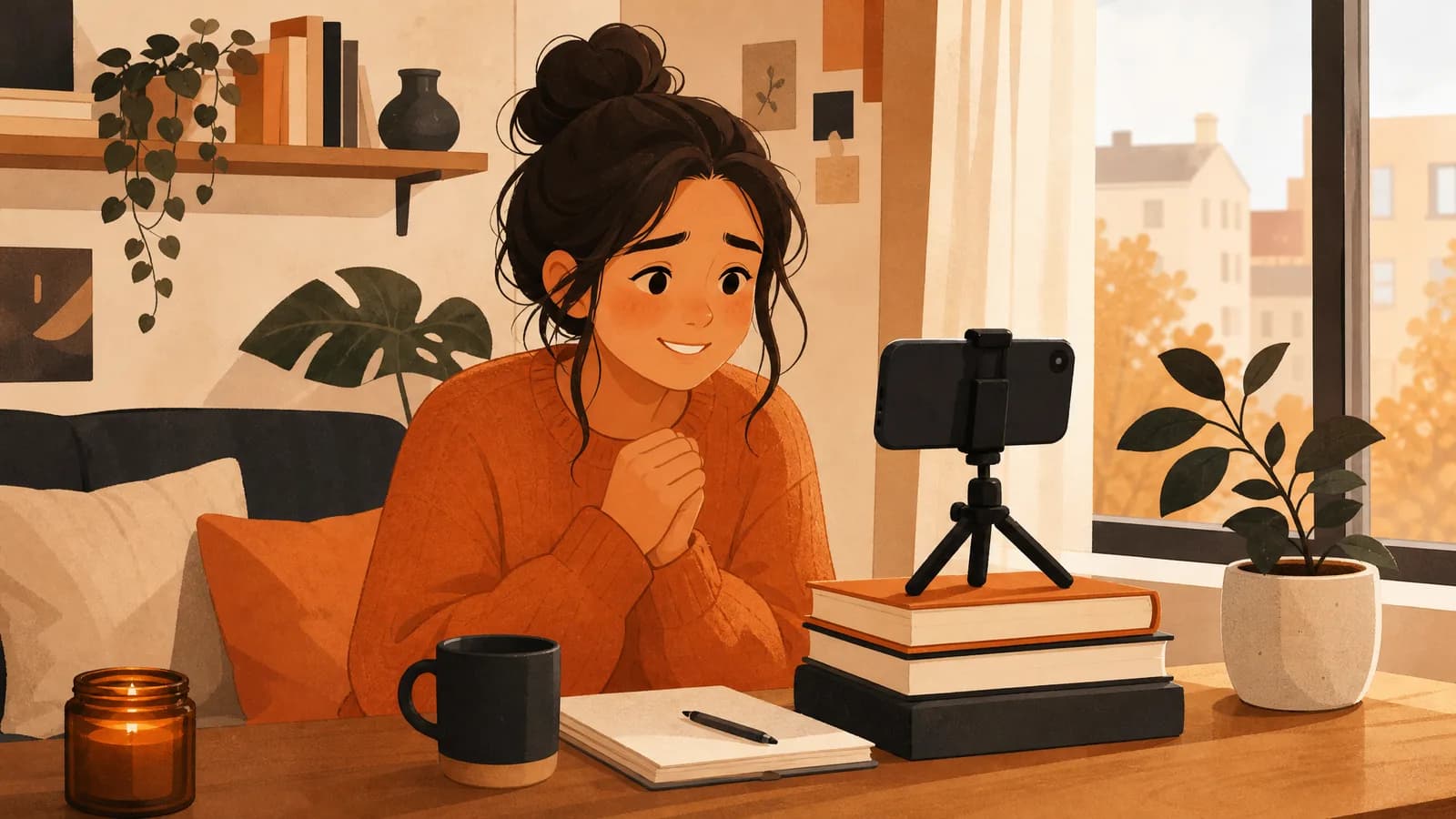
The first time I tried a “talking-head” video, I didn’t know the word. A coworker just said: open a channel, talk about the product, phone is fine. So I sat by a window and recorded eleven takes. Take eleven still sounded like I was reading a court verdict.
Only later did it click: a talking-head is you, facing the camera, saying something a stranger can follow.
Not a speech contest. Not a polished broadcast voice. Not your blog post read out loud.
What it looks like in the wild
You’ve already watched a hundred of them:
- Someone holds a cream and says what changed after a week
- Someone at a desk explains one Excel trick in three minutes
- Someone by a shelf answers “why this one” and stops
Mostly a face, hands, maybe a product. Short sentences. That’s talking-head. In Chinese creator circles they call it 口播 — same job, different label.
Three beginner traps I fell into
1. “I should memorize it.”
Don’t. Midway your brain blanks, your eyes flick up-left, and everyone sees you searching for the next line. Pros rarely memorize. They write, then prompt — paper, second screen, teleprompter. The goal is eyes near the lens, not a memory medal.
2. “One perfect take.”
Nope. I still trash two or three chunks on a one-minute video. Looking pro isn’t “one-take magic.” It’s stopping, restarting, and keeping the bit that sounds like a human.
3. “Write it like an article.”
Articles sound robotic when spoken. Real talk has “honestly,” “look,” “here’s the thing.” Put those in the script on purpose.
How I stopped sounding like a hostage video
A comment cured me: “You’re reading a board, right?”
That day I raised the phone, put the script on a laptop, and used a free online teleprompter so the text scrolled next to the lens. I slowed down on purpose. Still a little stiff — but it no longer felt like an exam.
If you’re stuck on the first sentence, shrink the goal:
Explain one thing. Sixty seconds is enough.
Three lines:
- Hook: You’ve probably hit ___
- Body: Here’s what I do ___
- Close: Next time, try ___
Paste it into the teleprompter, find a speed you can breathe with, read it twice. Then record with the script on screen. You’re not shipping cinema. You’re collecting a usable draft.
One last thing
Talking-head feels like a skill. It’s mostly a habit: short lines, willingness to re-record, and not flinching when you hear your own voice.
You don’t need to be “professional” first. You need one imperfect take. That ugly first version is usually the parent of every smoother video that comes after.